Two caskets look almost identical, and cost a thousand dollars apart. Here is what changed
A casket is four priced parts: shell, hardware, interior and gasket. Knowing which one moved explains most price gaps in a selection room.
Gauge runs backward
With steel caskets, a smaller gauge number means thicker metal, so 18 gauge is heavier than 20. Price rises as the number falls, because both the material and the finishing work increase.
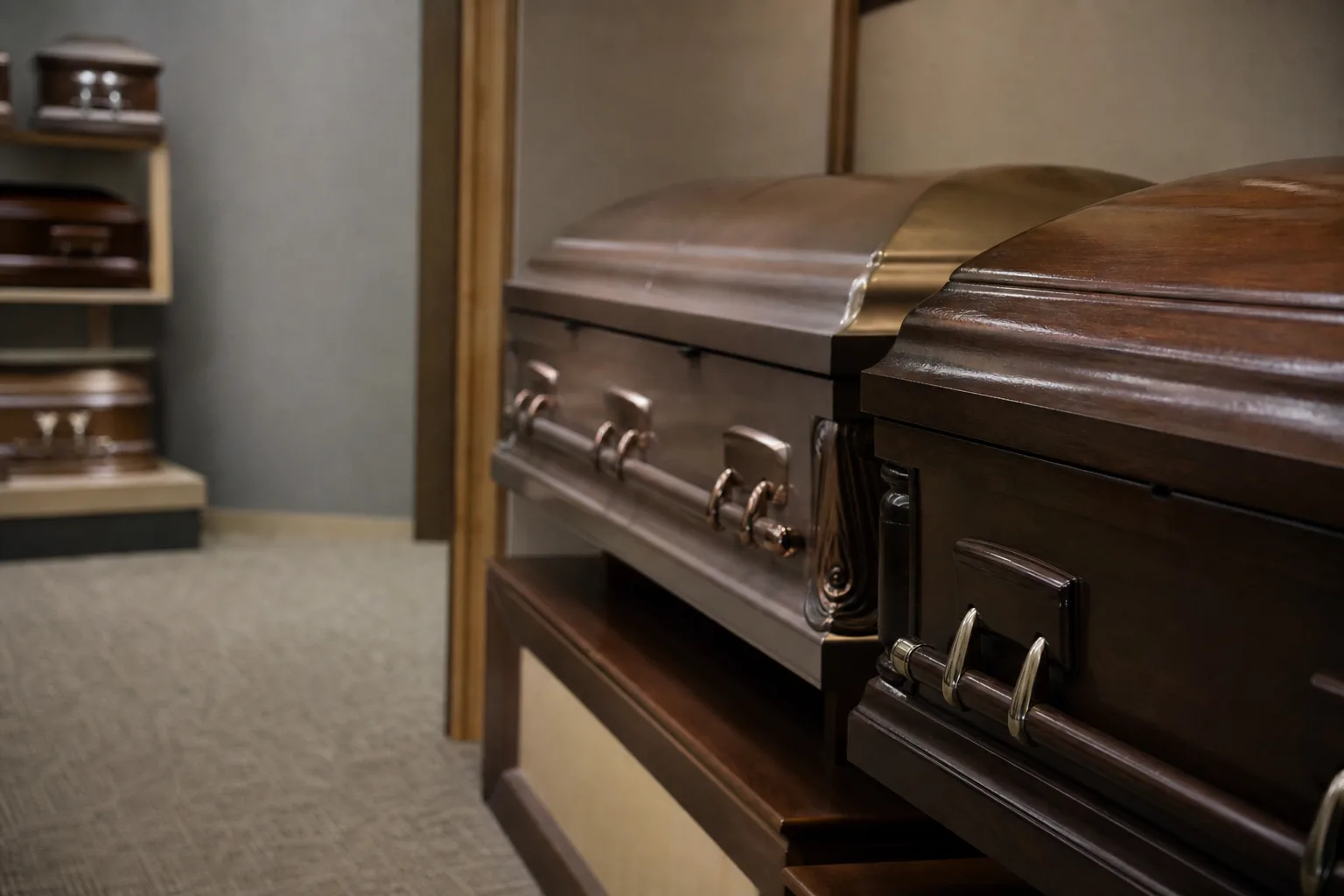
A selection room is arranged to make comparison hard. Caskets sit at an angle, half-open, lids raised toward the light, and the two you are deciding between are rarely next to each other. The price difference between them can be small or it can be a thousand dollars or more, and almost always the gap comes from one of four things: what the shell is made of, how thick it is, what is bolted to the outside, and what is sewn into the inside. Separate those four and the pricing stops being mysterious.
The shell carries most of the price
Steel is sold by gauge, and gauge runs backward: 20 gauge is thinner than 18, which is thinner than 16. The metal in a 16 gauge casket costs meaningfully more than the metal in a 20 gauge one, and the finish work usually rises with it, so the jump shows up twice. Above steel sit stainless, copper and bronze, the last two priced by weight per square foot rather than by gauge, which is why a bronze casket can cost several times a steel one that looks similar under a showroom light. Wood is priced by species and by whether it is solid stock or veneer. Poplar and pine sit at the bottom, oak and cherry in the middle, walnut and mahogany at the top.
Cloth-covered caskets are the plainest of the line. Underneath the fabric is pine, poplar or a composite board, and the covering is stretched crepe or a similar cloth rather than a finished surface. Nothing about that construction is defective; it is a wooden box with a soft exterior, and it does the same work in a grave or a crematory that a finished hardwood box does. What it will not do is hold a mirror polish, and that polish, on a solid hardwood shell, represents many hours of sanding, filling and spraying. You are looking at labor as much as lumber.
Hardware separates shells that are otherwise the same
Handles come in two families. Stationary bars are fixed in place; swing bars pivot down and are cast, plated and attached with more parts. A single casket shell from one manufacturer may appear in three different price positions in the same room, with the differences being swing bars instead of stationary, a hinged panel lid instead of a full-couch lid, and a heavier corner casting. Ask whether the shell underneath is the same model. Suppliers build lines this way on purpose, and funeral directors generally know which of their caskets share a body, because they order from the same catalog you are not being shown.
The interior is fabric, priced like fabric
Inside is a bed, a pillow, a lid panel and a skirt, made from crepe, twill, satin or velvet, and the price ladder runs roughly in that order. Velvet costs more than crepe because velvet costs more than crepe. Beyond material, you may be charged for an adjustable bed that raises or lowers with a crank, for a memory tube or drawer, for embroidery on the lid panel, and for extra tailoring at the corners. None of these affect how the casket performs. All of them are visible during the two hours anyone is looking at it, which is precisely why they are priced where they are.
What the gasket does, and what nobody may claim it does
A gasketed casket has a rubber seal in the rim and a crank-operated latch that draws the lid down against it. It resists the entry of outside air and water for some period, and that is the whole of its function. It does not preserve a body, and it does not make one. The Federal Trade Commission, which oversees how funeral goods are sold to the public, treats claims of long-term preservation as off-limits, and a straightforward funeral director will tell you the seal is a moisture barrier and stop there. Expect the gasket to add a few hundred dollars over the identical ungasketed model. Ask for both prices from the same line and the number becomes plain.
Reading two tags side by side
Take the printed casket price list, which you are entitled to have in hand, and write down for each candidate the material, the gauge or species, the handle type, the interior fabric and whether it is gasketed. Do it on paper. Four or five caskets resolve quickly into two or three real choices once the attributes are in a column, and the odd one out, the box priced far above its specification, becomes obvious. Then ask what the next model down in the same line costs, since manufacturers rarely make one shell in one configuration.
The honest answer to why two boxes differ by a thousand dollars is usually mundane: a heavier gauge, swing handles, velvet instead of crepe, a rubber seal. Once you can name the part that moved, you can decide whether you want it.