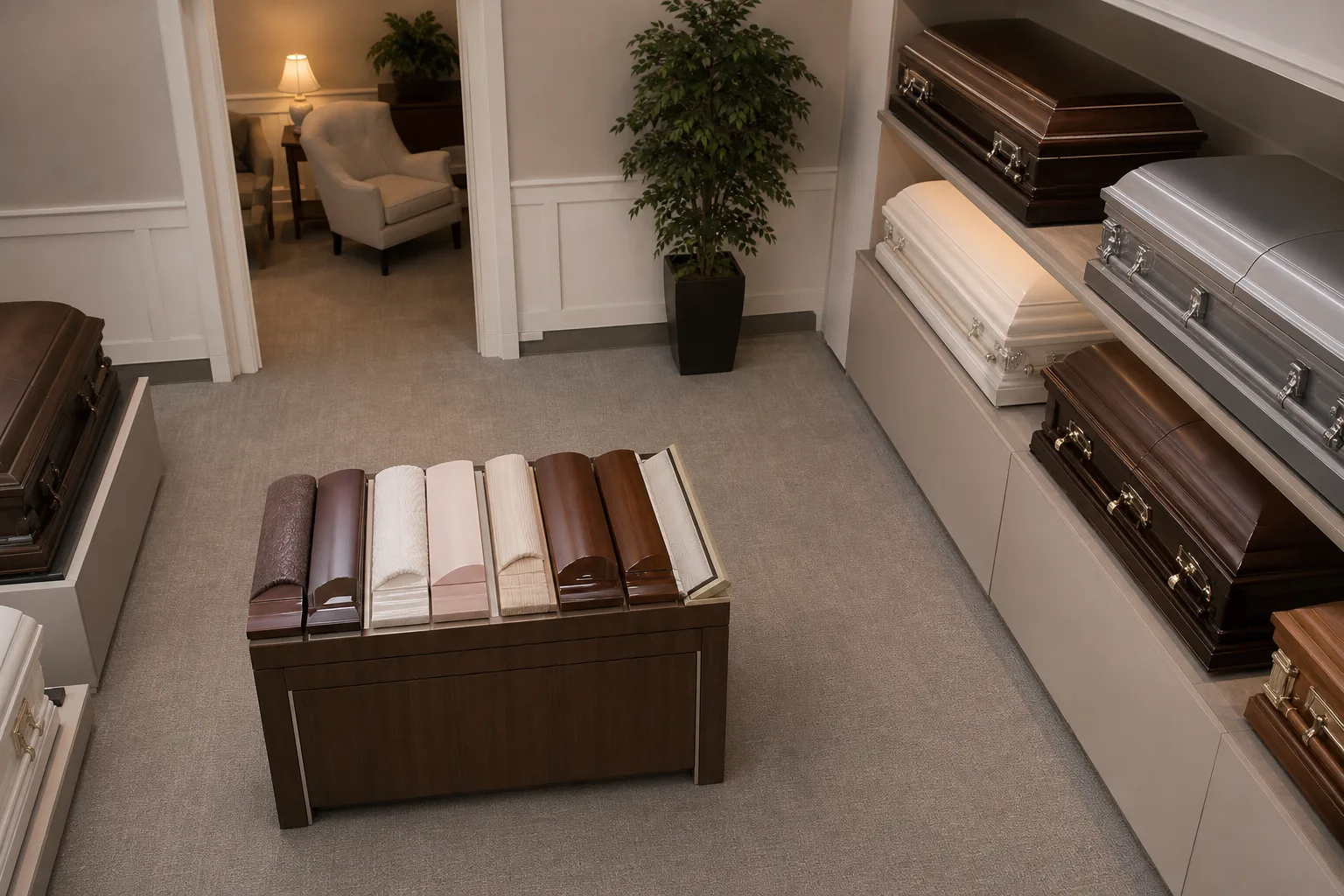
Most people arrive at a funeral home having already been shown a casket, either in a photograph a relative forwarded or in a selection room they were walked through within twenty minutes of sitting down. That is the wrong first decision, not because the container does not matter, but because its price is the one number in the arrangement that cannot be evaluated until three other things are settled. A casket bought before the cemetery's rules are known can turn out to be too wide for the grave liner, unnecessary for a cremation, or simply more box than the plot requires. The sequence matters more than any single choice inside it.
Disposition first, because it eliminates whole categories of spending
Burial, cremation, entombment in a mausoleum, and donation to a medical school are not four versions of the same purchase. Each one deletes or keeps entire line items. Choose cremation and the outer burial container question usually disappears, the embalming question usually disappears with it, and the container becomes either a rental shell for a viewing or a simple combustible box. Choose ground burial and you have inherited a cemetery, a plot, an opening and closing fee, a marker, and in most cases a vault or grave liner. Deciding this first is not morbid efficiency. It is the only way to know which of the several hundred dollars in optional charges on a price list apply to you at all.
Then the cemetery or crematory, because they set the constraints
The place that receives the body has rules, and those rules are contractual, not advisory. Cemeteries specify whether an outer burial container is required, what interior dimensions the grave will accept, what a marker may be made of, and how much notice they need for an opening. Crematories specify what a container may contain, which usually means no metal hardware, no glass, and nothing sealed. Call them directly and ask for the requirements in writing before anyone shows you merchandise, because the funeral home's account of what the cemetery requires and the cemetery's own account of it are not always the same document. A separate page on this site works through how to tell a genuine cemetery rule from a house preference.
The container third, once you know what it has to satisfy
By this point the shopping problem has become small and specific: a box of known maximum dimensions, in a material the receiving facility permits, at whatever price you decide is right. That is a comparison anyone can make. Independent retailers and online sellers list Caskets at prices that can be set beside a funeral home's own general price list, which is exactly the comparison the arrangement conference is not structured to invite. The Federal Trade Commission oversees the federal disclosure rules that govern how funeral goods and services are priced and presented, including a provider's obligation to accept a container the family obtained elsewhere. Another page here covers what that acceptance obligation looks like in practice, and a third covers where the money goes inside the casket itself: steel gauge, hardwood species, cloth over pine.
Everything itemized around it, last and separately
What remains after the container is settled is a list of services, and services are where the totals quietly reassemble themselves. The basic services fee is non-declinable and covers overhead, staff availability, and the paperwork. Everything after it is a choice: transfer of remains, refrigeration or embalming, use of facilities for a viewing, use of facilities for a ceremony, a hearse, a limousine, printed programs, an obituary placement, flowers. Ask for the itemized price list and go down it line by line, declining what the disposition you chose does not require. This is tedious work at a bad time, which is precisely why it is offered last, in bundles, at a stage when most families have stopped counting.
What reversing the order actually costs
The cost is not usually one dramatic overcharge. It is a series of small commitments made in the wrong sequence, each of which forecloses a cheaper option that was still available an hour earlier. Pick the casket first and you have anchored every later number to it, because a family that has just chosen a hardwood casket rarely then declines the matching vault, the matching register book, or the upgraded viewing package. Pick the package first and you have bought services that the disposition method may not need. Pick the cemetery last and you may discover that the plot you assumed was available requires a liner the casket will not fit inside. Order protects money in a way that negotiation does not.
None of this requires expertise, only that the four questions be asked in the order they depend on each other: what happens to the body, what the receiving facility requires, what container satisfies that requirement, and what services you actually want attached. Answered in that sequence, each decision is small and checkable, and the price list stops being a document you are reacting to.